


Bio:
Frazier King is a photographer, collector and curator, living and working in Houston, TX. His photography work focuses on constructed still life and the “Orchidaceae” prints are produced using film and gelatin silver prints. Over the last 25 years he has exhibited in numerous solo and group shows in the U.S., Canada, Mexico, Brazil, France, and Belgium. His work is included in the collections of many individuals and the Museum of Fine Arts, Houston; Harry Ransom Center, Austin, TX; George Eastman House, Rochester, NY; Bibliothèque nationale de France, Paris, France; and Museu de Arte Moderna, Rio de Janeiro, Brazil. He has been a collector since the 1990s. His collection was shown by FotoFest in 2012 in “The Collector’s Eye II” exhibition and, in conjunction with FotoFest, he produced a book entitled “The Collector’s Eye—A Photographer’s View of His Contemporaries”. The collection was also exhibited at the Griffin Museum in November and December 2024. During his 15 years serving as a member of the board of directors of HCP, he curated or co-curated exhibitions and participated as a reviewer in photography portfolio review events around the world.
Statement:
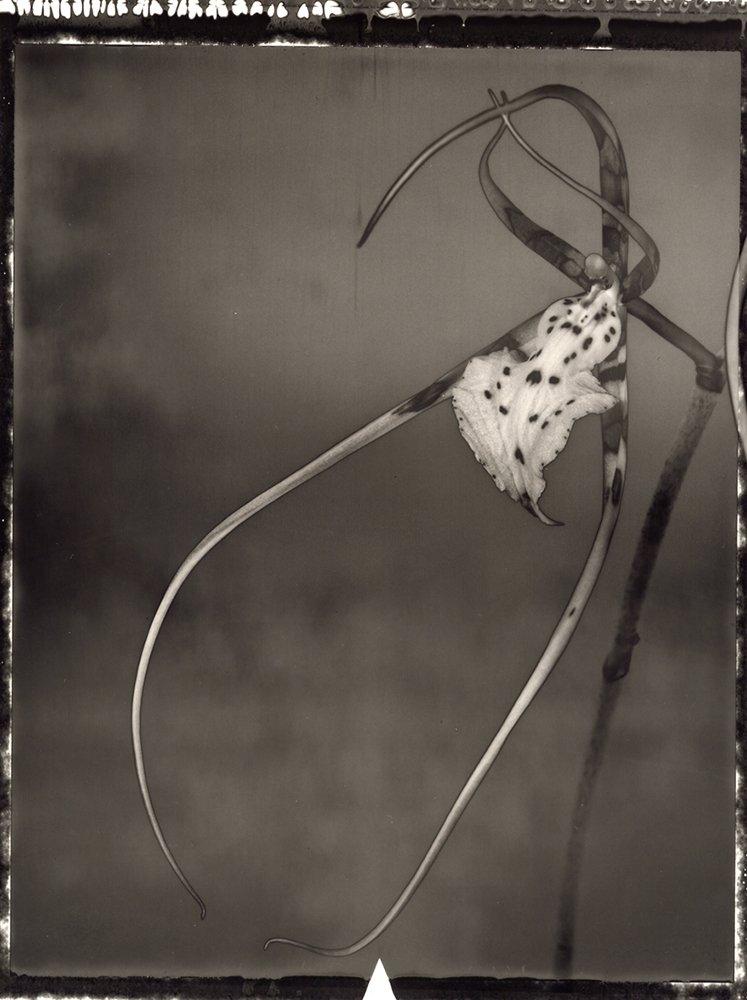
Orchid blossoms transcend their daily existence. Of course, each exists as a wonderful, sensuous blossom. However, each blossom also seems to exist in another world. In some cases, a blossom will join the human world. One may be a caricature of a human figure, such as a ballerina or a whirling dervish. Another may convey a gesture, like a courtesy. Many blossoms also have a very human sensuality: with veins and shapes that are like our own. In other cases, a blossom may be from a strange and distant world. We may see a strange prehistoric bird or a small spacecraft from a distant planet. The nature of their existence is limited only by the imagination of the beholder. They speak to each beholder differently, in a very intimate way, in the way in which the viewer is open.
I use a 4 x 5 Deardorff with a long lens and long bellows to capture the essence of the blossom. I then subject each negative to the solarization technique (made famous by Man Ray) in order to create the atmosphere or environment in which each orchid blossom lives its unique existence. Each negative is printed in a straightforward way on warm tone silver gelatin paper and toned with selenium.
