


BIO:
Roberta Holden is a Canadian photographer, who literally grew up on the water, living aboard a sailboat built by her father. She headed offshore when she was just 7months old, sailing from Vancouver, Canada, to New Zealand. She later sailed to the Arctic and twice to Antarctica, including as a member of the first all-female expedition in 2002. These oceanic and polar experiences persisted as themes in her work as a photographer.
STATEMENT:
Greenlandic sled dogs—qimmit—are explored throughout this body of work, not simply as subjects, but as collaborators in a living cultural system. In Greenland, these dogs are far more than a means of transportation; they are embedded in identity, survival, and knowledge passed down through generations. To travel by dog team is to enter into this relationship and to witness a form of knowledge that is physical, relational, and deeply place-based.
The dogs carry histories that extend thousands of years. They accompanied Inuit migrations into Greenland and became essential partners in hunting and mobility across harsh Arctic environments. Even today, they remain active participants in daily life in northern communities, shaping how people move across the land. Most are not pets, but working animals, living in symbiosis with humans, in a system of life in which movement, survival, and relationship are inseparable.
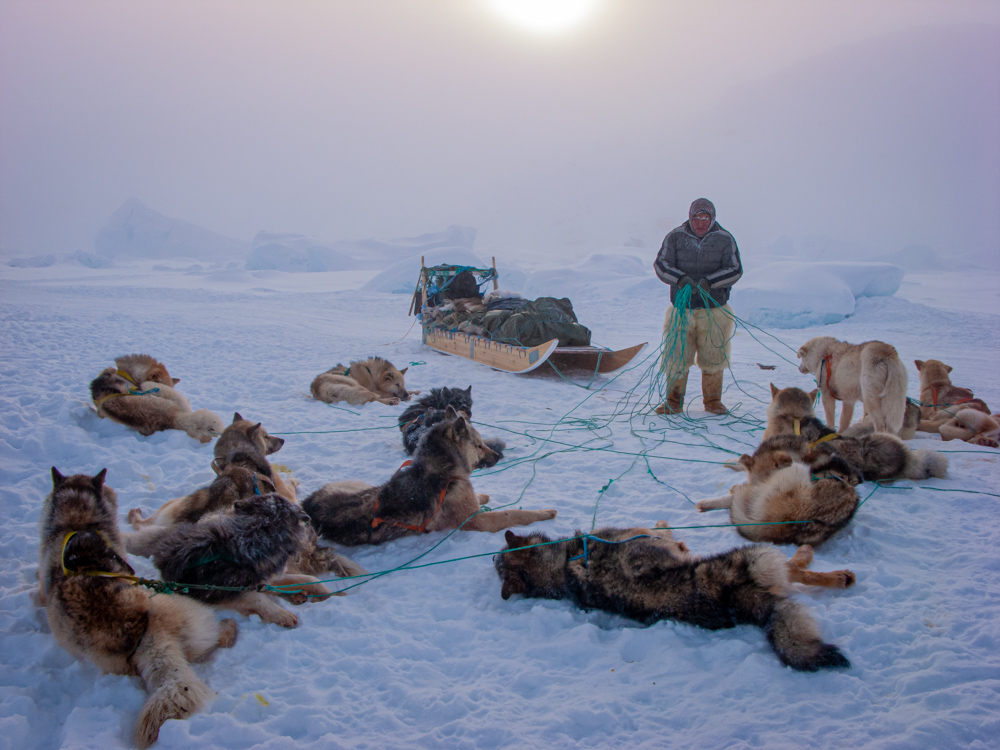
The images situate the dogs within a network of relationships: between ice and body, labour and stillness, human and animal. What is visible in these images is not nostalgia, but continuity under pressure—a culture that persists through adaptation. The selected image was taken along the Northwest coast of Greenland, near Nuussuaq, the northernmost community accessible by air, during an Artist in Residence based in Upernavik.
The sled is loaded with halibut, a staple of Greenland’s commercial fishing industry. Halibut is a deep sea fish, requiring an overnight trip by dog team to reach the fishing grounds. The dogs provide labour to reach these distant fishing holes and are fed the bycatch to fuel their return journey.
In early March, daylight hours are few and used for travel and navigation, while long hours of darkness and bitter cold were spent fishing through the sea ice. We used the sled, lined with sealskin, as a sleeping platform, covered in a makeshift canvas tent. In this image, the dogs enjoy a short break to detangle their tethers on the journey back to town.
